
What Are the 7 Main Types of AI in 2026?
Introduction to AI in 2026
Artificial Intelligence in 2026 is no longer something futuristic—it’s woven into almost everything we touch. From personalized news feeds to autonomous delivery drones flying across cities, AI has become a daily necessity. But despite its presence everywhere, many people still wonder:
“How many types of AI actually exist?”
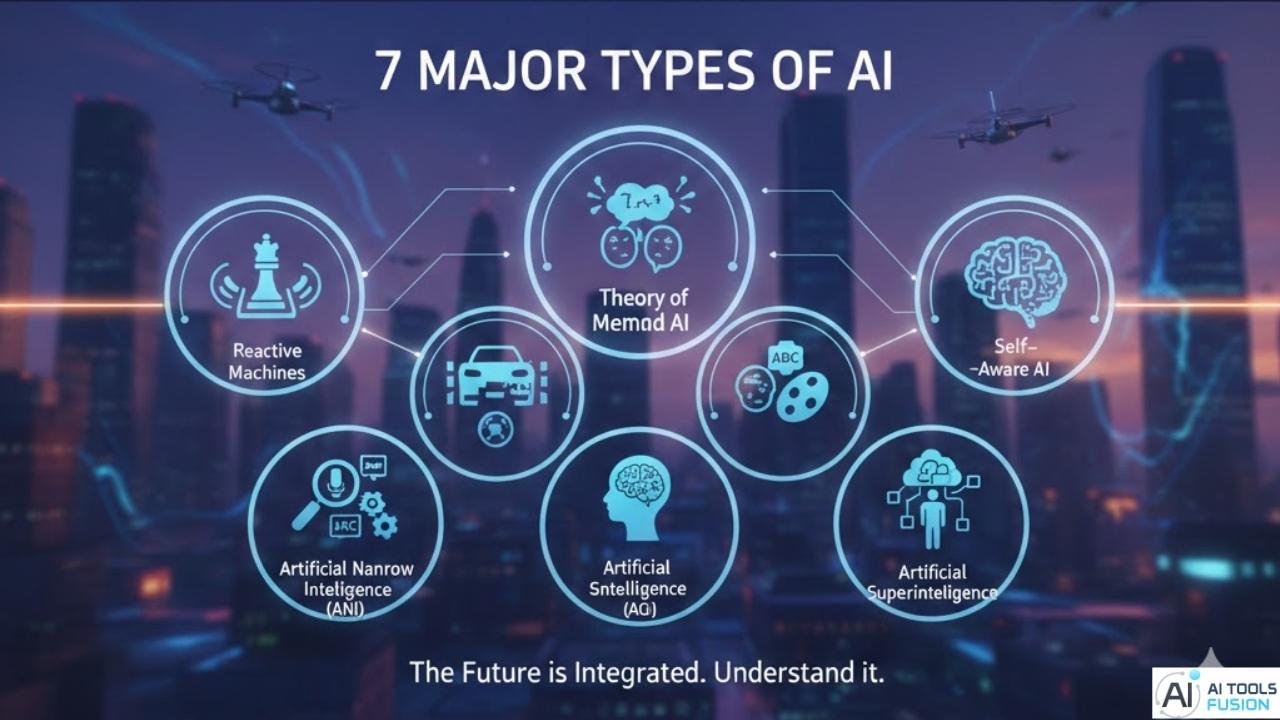
To help you understand AI better, we’re breaking it down into 7 major types that define the current and future landscape of artificial intelligence.
This guide explains each type in simple words, with examples you can relate to, making it easy for anyone—from beginners to tech enthusiasts—to understand.
How AI Has Evolved Rapidly
If we compare AI to a growing child, it has gone from learning the alphabet to writing novels in just a few years.
Early AI was rule-based and predictable. By 2026, AI will be creative, multimodal, emotion-aware, and capable of reasoning—something nobody imagined happening so fast.
Why Understanding AI Types Matters Today
Whether you run a business, love technology, or simply use a smartphone, knowing AI categories helps you:
- Make better decisions
- Know what AI can do
- Know what it cannot do (yet!)
- Understand the direction technology is heading
7 Main Types of AI
1. Reactive Machines AI
Reactive Machines are the “old-school” AI. They only respond to situations; they don’t learn or store past experiences.
Definition
These AIs operate purely in the moment. They analyze the current input and produce an output instantly—like a calculator.
Real-World Examples in 2026
- Older chess-playing softwares
- Basic email spam filters
- Smart home sensors that turn lights on/off
- Simple industrial robots
Reactive AI is reliable, predictable, and super fast—but that’s because it doesn’t “think.”
Pros and Cons
Pros:
- Accurate for repetitive tasks
- Fast and stable
- Easy to implement
Cons:
- No learning ability
- Cannot improve over time
- Limited to very basic tasks
2. Limited Memory AI
This is the AI we use the most in today’s world. Limited Memory AIs learn from data, remember past actions, and improve continuously.
How It Works
They study datasets, find patterns, store relevant information, and use it for future decisions.
It’s almost like AI having a short-term memory.
Use Cases in 2026
- Self-driving cars analyzing nearby vehicles
- Chatbots that adapt to your writing style
- Social media algorithms recommending content
- Predictive bank systems analyzing fraud behavior
Strengths and Weaknesses
Strengths:
- Learns from past data
- Can make better predictions over time
- More flexible than Reactive AI
Weaknesses:
- Memory still limited
- Cannot understand emotions or deeper meanings fully
- Needs large datasets
3. Theory of Mind AI
This is where AI becomes more “human-like.” It tries to understand thoughts, emotions, and motivations.
What Makes It Different
Theory of Mind AI doesn’t just see your actions; it tries to understand why you took them.
Imagine an AI that knows when you’re stressed, sad, or confused—and adjusts its responses accordingly.
Current Stage in 2026
We’re not fully there yet, but progress is exciting:
- Emotion-detection AI analyzing facial expressions
- AI that senses user frustration
- Customer service bots that adapt based on tone
- Early emotional recognition in robotics
Why It’s a Game-Changer
It could revolutionize:
- Mental health therapy
- Robotics
- Education
- Customer service
- Human-AI relationships
4. Self-Aware AI
Self-aware AI is the highest—and most theoretical—form of intelligence.
Concept and Future Possibilities
Such AI would:
- Understand itself
- Have consciousness
- Form independent decisions
- Have self-generated goals
This is the kind of AI we often see in sci-fi movies.
Ethical Concerns
If an AI becomes self-aware:
- Should it have rights?
- Who controls it?
- How do we ensure safety?
- Could it become unpredictable?
How Close We Are in 2026
We’re still far away. But advancements in AGI hint that early versions of self-awareness could develop in the next few decades.
5. Artificial Narrow Intelligence (ANI)
ANI is everywhere. It’s the most common type of AI in 2026.
Functions and Applications
ANI specializes in one task but does it extremely well:
- Chatting
- Translating
- Diagnosing
- Detecting objects
- Generating text or images
Examples in 2026
- ChatGPT
- Face recognition
- Image generators
- Finance prediction AI
- Social media moderation tools
Limitations
ANI cannot multitask or think beyond its programmed purpose.
6. Artificial General Intelligence (AGI)
AGI aims to match or exceed human intelligence across all fields.
Definition of AGI
AGI can:
- Analyze
- Understand
- Reason
- Learn
- Create
- Adapt
Just like a human being—only faster.
2026 Progress Toward AGI
Companies like OpenAI, DeepMind, and Meta are working hard on AGI. In 2026, we see early glimpses:
- AI that solves unseen problems
- AI agents completing complex tasks
- AI reasoning like humans
- AI learning with minimal data
Challenges to Achieve AGI
- Safety protocols
- Bias control
- Massive computing needs
- Ethical limitations
7. Artificial Superintelligence (ASI)
ASI is AI that is smarter than humans in every way.
What ASI Means
ASI would surpass humans in:
- Logic
- Creativity
- Scientific discovery
- Emotional understanding
- Problem-solving
It could potentially cure diseases, solve climate change, and revolutionize every industry.
Risks and Opportunities
Opportunities:
- Advanced health discoveries
- Faster research
- Smarter economies
- Breakthrough technology
Risks:
- Loss of human control
- Manipulation if misused
- Ethical conflicts
When Experts Predict ASI May Arrive
Some predict it may appear by 2050–2100, while others believe it may not fully exist at all.
Bonus: Emerging AI Categories in 2026
Multimodal AI
AI that processes multiple types of data—text, voice, images, video—and responds intelligently.
ChatGPT Vision and Gemini are examples.
Autonomous Agent AI
AI agents that run tasks independently—managing emails, running ads, making decisions without constant human input.
Bio-AI & Neuro-Symbolic Systems
These combine brain-like learning with traditional logic, making AI smarter and more human-like.
How These 7 Types of AI Shape the Future
Impact on Industries
AI is reshaping:
- Healthcare (robotic surgeries, early diagnosis)
- Finance (fraud detection, predictions)
- Transportation (autonomous travel)
- Education (personal tutors)
- Entertainment (AI-created films, music, games)
Impact on Daily Life
AI affects:
- Shopping
- Driving
- Studying
- Working
- Healthcare
- Communication
In short, AI is becoming a digital partner in almost everything.
Conclusion
The seven main types of AI—Reactive, Limited Memory, Theory of Mind, Self-Aware, ANI, AGI, and ASI—give us a clear roadmap of where technology stands today and where it’s heading. In 2026, we’re living in a revolutionary era where AI is more powerful, more helpful, and more integrated into our lives than ever before.
As research continues, we’re inching closer toward AGI and possibly ASI, opening the doors to endless possibilities.
The future of AI isn’t just coming—it’s already here.
FAQs

1. Which type of AI is most common in 2026?
Artificial Narrow Intelligence (ANI).
2. Is AGI already here?
Not fully, but we’re extremely close.
3. What AI type is ChatGPT?
ChatGPT is ANI with elements of Limited Memory and early cognitive reasoning.
4. Which AI type is used in Robotics?
Mostly ANI, with growing integration of Theory of Mind features.
5. What AI type is the future?
AGI and ASI—though both require decades of research and careful development.
See Also: Best 9 AI Tools for Business in 2026: Overview, Pros, Cons, Pricing & Ease of Use