
How Can a Beginner Start Learning AI: 2026 Guide
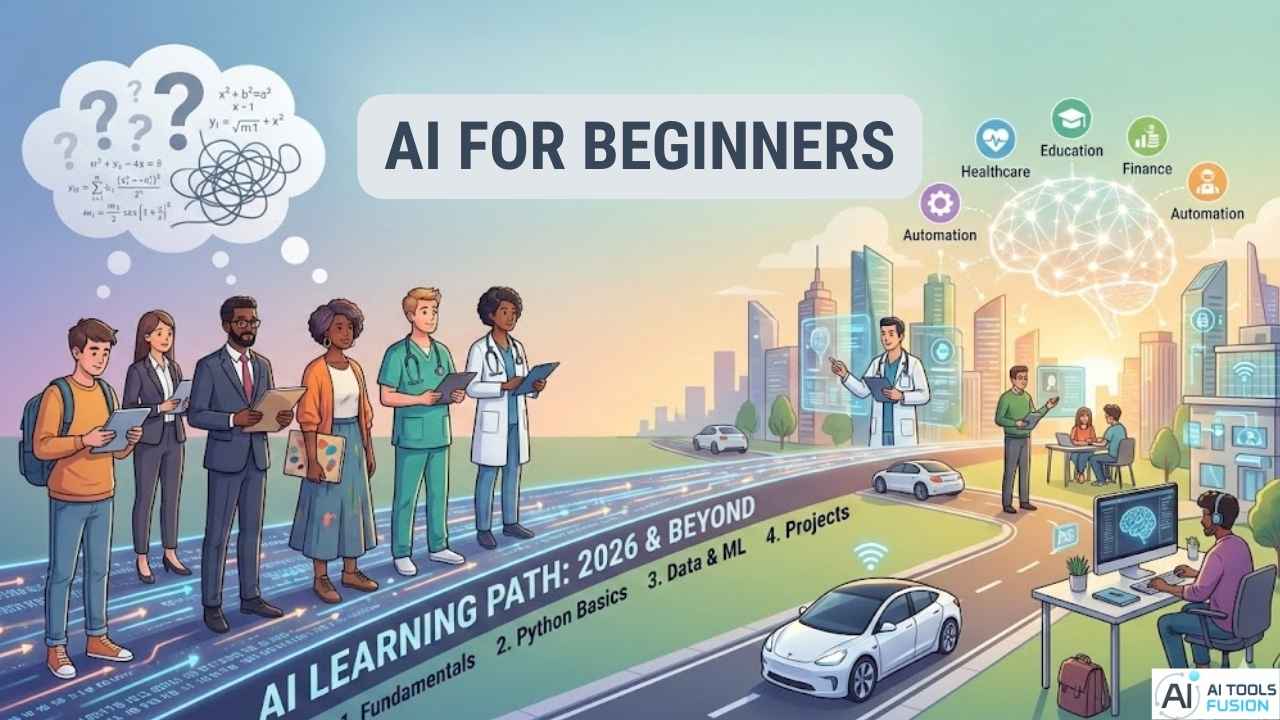
Artificial Intelligence (AI) is no longer something we talk about as “the future.” In 2026, AI is the present. It decides what videos you watch, helps doctors detect diseases early, powers customer support chatbots, drives cars, writes content, and even helps students learn faster.
If you’re a beginner with little or no technical background, you might feel excited—but also confused. Questions like “Where do I start?”, “Is AI too hard?”, or “Do I need to be good at math or coding?” probably come to mind.
Good news: learning AI in 2026 is easier than ever. This guide is written in plain English, step by step, with real-life examples, so anyone can understand and start confidently.
Let’s begin.
Introduction to Artificial Intelligence in 2026
AI in 2026 is everywhere, yet invisible. You don’t always notice it, but it’s working behind the scenes to make life easier and faster.
Why AI Skills Matter More Than Ever
AI is transforming every industry:
- Healthcare: AI helps detect cancer early and analyze medical reports
- Education: Personalized learning powered by AI tutors
- Marketing: Smart ads, customer behavior prediction
- Finance: Fraud detection, trading bots
- Business: Automation, decision-making, analytics
Learning AI gives you:
- Career security
- Higher-paying job opportunities
- The ability to automate tasks
- A competitive edge in almost any field
In short, AI is becoming as essential as knowing how to use the internet.
Is AI Too Complex for Beginners?
This is one of the biggest fears—and the answer is no.
Think of AI like learning to cook. You don’t start by becoming a master chef. You start by boiling eggs. AI learning works the same way. You begin with basics, practice small things, and slowly build skills.
Modern AI tools are designed for beginners. Many hide complex math and logic behind simple interfaces.
Understanding the Basics of AI
Before diving into learning paths, it’s important to understand what AI actually is.
What Is Artificial Intelligence in Simple Words?
Artificial Intelligence means teaching machines to think, learn, and make decisions like humans.
Instead of following fixed rules, AI systems:
- Learn from data
- Improve with experience
- Adapt to new situations
Example:
When YouTube recommends videos, it’s AI learning your preferences.
Key AI Concepts Every Beginner Must Know
Let’s break down AI into simple building blocks.
Machine Learning (ML)
Machine Learning allows computers to learn from data instead of being manually programmed.
Example:
- Spam email filters
- Product recommendations
- Weather prediction
ML is the foundation of most AI systems.
Deep Learning
Deep learning is a more advanced type of machine learning inspired by the human brain.
It uses neural networks to process large amounts of data.
Used in:
- Face recognition
- Speech recognition
- Self-driving cars
Natural Language Processing (NLP)
NLP helps machines understand and generate human language.
Examples:
- Chatbots
- Voice assistants
- Language translators
If a machine can read, write, or talk—it’s using NLP.
Computer Vision
Computer vision allows machines to “see” and understand images and videos.
Used in:
- Facial recognition
- Medical imaging
- Security cameras
Common AI Myths That Stop Beginners
Myth 1: You Must Be a Math Genius
Reality:
You don’t need advanced math to start learning AI. Most tools handle math internally. You can learn math gradually if needed.
Myth 2: AI Is Only for Programmers
Reality:
AI is used by marketers, designers, writers, teachers, and business owners. Coding helps—but it’s not mandatory at the start.
Skills You Need to Start Learning AI
Basic Computer Knowledge
If you can:
- Use a browser
- Install apps
- Use email
You’re ready to start.
Curiosity and Problem-Solving
AI rewards curiosity more than intelligence. Asking “Why?” and “How?” is the real skill.
Math (Optional but Helpful)
Basic understanding of:
- Percentages
- Graphs
- Averages
That’s enough for beginners.
Choosing the Right Programming Language for AI
Why Python Is the Best Choice in 2026
Python is:
- Easy to read
- Beginner-friendly
- Powerful
Most AI libraries are built using Python, making it the #1 choice for beginners.
Other Languages Used in AI
- R: Data analysis
- JavaScript: Web-based AI
- Julia: Research-focused AI
Still, Python remains the best starting point.
Step-by-Step Roadmap to Learn AI From Scratch
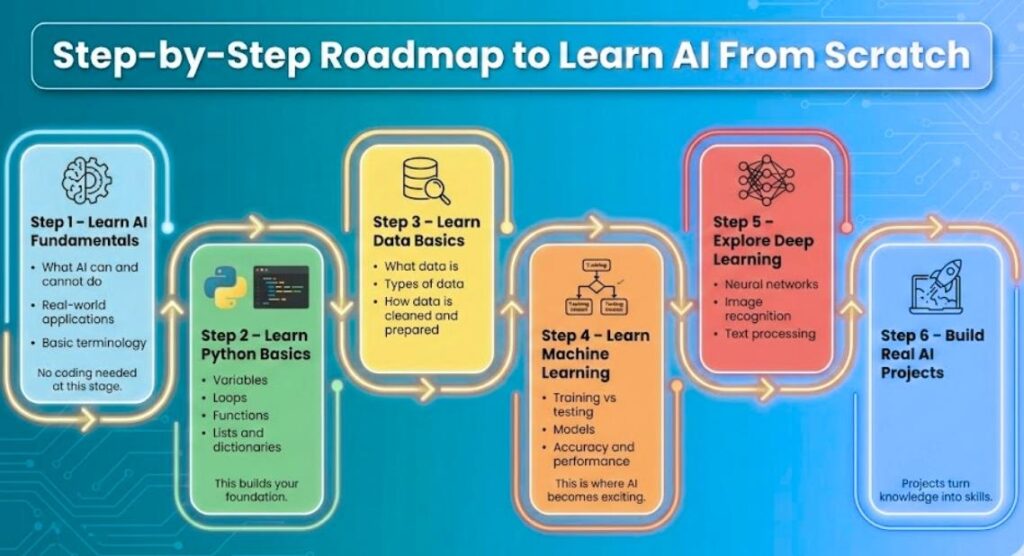
Step 1 – Learn AI Fundamentals
Start by understanding:
- What AI can and cannot do
- Real-world applications
- Basic terminology
No coding needed at this stage.
Step 2 – Learn Python Basics
Focus on:
- Variables
- Loops
- Functions
- Lists and dictionaries
This builds your foundation.
Step 3 – Learn Data Basics
AI works on data. Learn:
- What data is
- Types of data
- How data is cleaned and prepared
Step 4 – Learn Machine Learning
Understand:
- Training vs testing
- Models
- Accuracy and performance
This is where AI becomes exciting.
Step 5 – Explore Deep Learning
Learn:
- Neural networks
- Image recognition
- Text processing
Step 6 – Build Real AI Projects
Projects turn knowledge into skills.
Best AI Learning Resources in 2026
Online Courses
Beginner-friendly platforms:
- Coursera
- Udemy
- edX
YouTube Channels
Free tutorials explain AI visually and simply.
Communities and Forums
Join:
- AI discussion groups
- Online forums
- Social media communities
How Long Does It Take to Learn AI?
Realistic Learning Timeline
- Basic understanding: 1–2 months
- Intermediate skills: 6 months
- Job-ready skills: 9–12 months
Consistency matters more than speed.
Beginner-Friendly AI Projects
Simple AI Project Ideas
- Chatbot using text input
- Image classification
- AI-powered recommendation system
Why Projects Matter
Projects:
- Build confidence
- Improve understanding
- Impress employers
Using AI Tools to Learn Faster
AI Coding Assistants
These tools:
- Explain errors
- Suggest improvements
- Save learning time
No-Code and Low-Code AI Tools
Perfect for beginners who want results quickly.
Common Mistakes Beginners Make
- Learning Too Many Things at Once: AI is huge. Focus on one area at a time.
- Skipping Practice: Reading alone won’t work. Practice is essential.
Career Opportunities After Learning AI
Entry-Level AI Jobs
- AI Assistant
- Data Analyst
- Machine Learning Intern
Freelancing and Remote Work
AI skills open global opportunities.
AI for Non-Technical Backgrounds
Learning AI Without Coding
You can start with:
- Prompt engineering
- AI automation tools
- No-code platforms
Career Transition With AI
AI blends well with:
- Marketing
- Healthcare
- Finance
- Education
Future of AI Learning Beyond 2026
How AI Education Is Evolving
AI learning is becoming:
- Personalized
- Interactive
- Project-based
Lifelong Learning in AI
AI evolves constantly. Continuous learning is key.
Conclusion
Learning AI in 2026 is one of the smartest decisions a beginner can make. You don’t need to be a genius, a programmer, or a mathematician. All you need is curiosity, consistency, and the right roadmap. Start small, practice regularly, and grow step by step. AI is not here to replace you—it’s here to empower you.
FAQs

Is AI difficult for beginners?
No. With beginner-friendly tools and structured learning, AI is very approachable.
Do I need coding to learn AI?
Not initially. Coding helps later, but many tools don’t require it.
What is the best AI skill to start with?
Machine learning fundamentals and Python basics.
Can non-technical people learn AI?
Yes. Many successful AI learners come from non-technical backgrounds.
Is AI a good career in 2026?
Yes. AI careers are in high demand globally.
See Also: What Are the 7 Main Types of AI?