
AI in Healthcare: Ensuring Ethical Technology in Patient Treatments

As artificial intelligence steadily weaves its way into the fabric of healthcare, the dual-edged nature of its integration becomes increasingly apparent. Technologies like Dentalx are not only transforming dental care by enhancing diagnostics and personalizing treatment plans but also prompting vital ethical deliberations. The allure of improved accessibility and efficiency is hard to ignore; however, these advancements bring to the forefront pressing issues of patient privacy, data security, and algorithmic bias. This article delves into the ethical landscape of AI in healthcare, urging healthcare providers to balance technological innovation with unwavering commitment to ethical standards and equitable patient care.
Table of Contents
How AI is Transforming Healthcare: Innovations and Ethical Challenges
Innovations in AI Healthcare
AI is revolutionizing healthcare with groundbreaking innovations like Dentalx AI, which is enhancing dental diagnostics with precision. The technology empowers dentists by analyzing intricate images, leading to early disease detection and more effective treatment plans. Beyond dental care, AI is facilitating personalized treatment plans, crafting healthcare regimens that cater to individual patient needs and genetic profiles. The result? Better health outcomes and optimized care delivery.
Another transformative innovation is the improvement in healthcare accessibility. AI tools break geographical barriers, enabling remote diagnostics and consultations, which democratizes access to quality healthcare for underserved communities. This progress in health technologies cements AI’s role as a pivotal player in healthcare innovation.
Ethical Challenges in AI Integration
However, with these advancements come serious ethical considerations. Patient privacy is at the forefront, as AI systems require vast amounts of personal health data, raising concerns about unauthorized access and misuse. Data security must be fortified to protect sensitive information against breaches.
Additionally, addressing algorithmic bias is crucial for ensuring AI fairness. Ethical technology mandates that AI in healthcare remains unbiased in diagnosing and treating patients, promoting equitable access to all individuals regardless of ethnicity, background, or socio-economic standing. Thus, balancing innovation with privacy and ethics is essential for sustainable AI integration in healthcare systems.
How AI is Used in Healthcare: The Role of Dentalx AI in Revolutionizing Dental Care
Precision Diagnostics and Beyond
AI in healthcare is redefining precision thanks to innovations like Dentalx AI. Traditional imaging methods often fall short due to issues such as image overlap and distortion. However, Dentalx AI leverages advanced techniques like convolutional neural networks to overcome these limitations. This AI-powered tool automates the identification of dental anomalies, such as caries and fractures, enhancing diagnostic accuracy significantly. By enabling precise image segmentation and 3D modeling, Dentalx AI supports dentists in formulating more effective treatment plans and improves patient outcomes, as outlined in various studies available online.
Streamlined Operations and Improved Care
Implementing AI like Dentalx in dental practices not only boosts diagnostic precision but also streamlines operations. Automated administrative tasks free up time for clinicians to focus more on patient care. AI’s role extends to optimizing workflow efficiency by quickly analyzing X-rays and scans, leading to quicker and more accurate diagnostics. This streamlining enables practices to deliver services faster, reducing waiting times for patients and improving overall care.
Ethical Considerations and Patient Privacy
While Dentalx AI enhances healthcare innovation, it also raises ethical concerns, particularly around data privacy. Every AI application must ensure robust data security measures to protect sensitive patient information. Healthcare providers need to address algorithmic biases, ensuring equitable access to AI-driven diagnostics across diverse populations. Implementing ethical technology practices and obtaining informed consent is crucial for maintaining trust and integrity in AI-driven healthcare. Balancing innovation with these ethical considerations will be essential to harness the full potential of AI in healthcare.
Ethical Implications: Patient Privacy and Data Security Concerns
Navigating Patient Privacy
The integration of AI in healthcare systems, like Dentalx AI, presents substantial ethical challenges, primarily surrounding patient privacy. In the digital age, personal health data is susceptible to breaches, unauthorized access, and misuse. Current regulations, such as the Health Insurance Portability and Accountability Act (HIPAA), have struggled to keep up with the technological advancements, leaving potentially sensitive data unprotected. Unlike the European Union’s stringent General Data Protection Regulation (GDPR), which mandates explicit consent for collecting sensitive health data, many global frameworks lack robust mechanisms to safeguard this information against exploitation by tech companies.
Ensuring Data Security
Addressing data security concerns necessitates the employment of comprehensive safeguards. This entails encryption techniques, rigorous access controls, and regular security audits to mitigate risks of data breaches and misuse. Moreover, involving diverse stakeholders in AI development can bolster trust and ensure fairer, more reliable AI systems. Protecting data without stifling innovation requires innovative strategies and collaborations. Experts emphasize that healthcare providers must implement robust protocols that go beyond what is currently mandated, thereby promoting transparency and maintaining patients’ trust in AI-driven healthcare solutions.
Addressing Algorithmic Bias
The ethical challenges extend beyond privacy to include the risk of algorithmic bias. Training AI models on non-representative data could perpetuate existing healthcare disparities, particularly affecting marginalized communities. Solutions require inclusive data collection practices and continuous monitoring to ensure AI systems provide equitable healthcare. Implementing representative datasets and rigorous bias testing, as highlighted by recent studies, can help bridge this gap, fostering AI technologies that support all patients fairly. This proactive approach will help in fostering an ethical relationship between AI and healthcare, ensuring technology serves public health effectively.
Overcoming Algorithmic Bias in AI-Powered Healthcare Systems
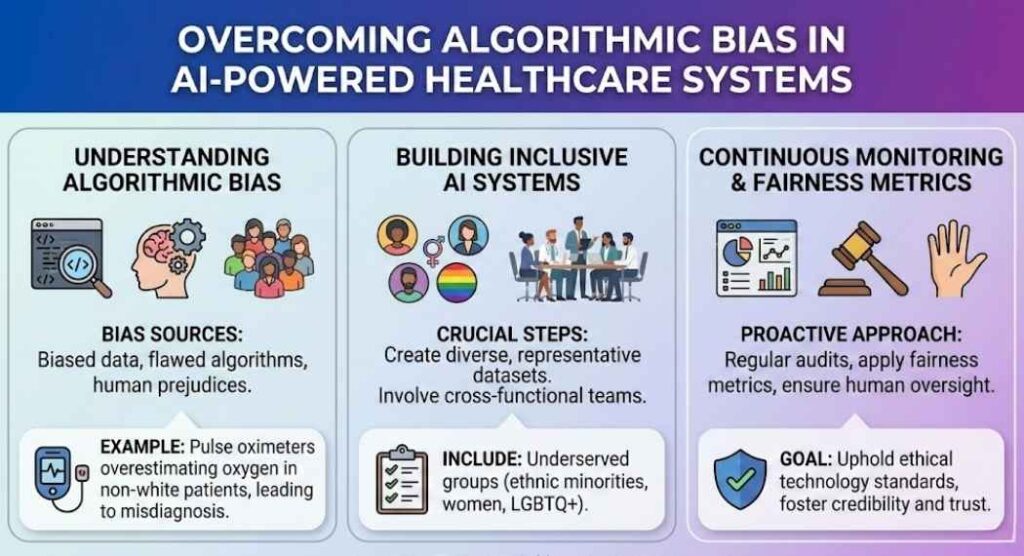
Understanding Algorithmic Bias
Algorithmic bias in healthcare AI systems is not merely a technical glitch but a significant threat that could perpetuate inequalities. These biases arise from the intricate web of biased data, flawed algorithms, and human prejudices. For instance, pulse oximeters that overestimate oxygen levels in non-white patients showcase how these biases can lead to severe clinical outcomes by misdiagnosing and misallocating care.
Building Inclusive AI Systems
To tackle this pervasive issue, creating diverse and representative datasets is crucial. It is vital to include data that encapsulates varying demographics, such as ethnic minorities, women, and LGBTQ+ populations. This approach helps counter data biases that occur when training data lacks adequate representation of underserved groups. The incorporation of diverse data not only aids in correcting current missteps but also fosters inclusive AI systems designed for equity. Further, involving cross-functional teams in the development and validation processes can enhance fairness and transparency.
Continuous Monitoring and Fairness Metrics
After deploying AI in healthcare, systems should be continuously monitored to detect emerging biases. This involves applying fairness metrics and conducting regular audits to ensure that algorithms remain unbiased and serve all patient populations equitably. A proactive approach, focusing on accountability, ensures that AI systems like Dentalx AI not only enhance healthcare innovation but also uphold ethical technology standards. Incorporating human oversight and explainability into these systems reinforces their credibility and trust among various stakeholders.
What Jobs Will AI Replace in Healthcare? A Look at Changing Roles
The Transformation of Healthcare Roles
In the rapidly evolving landscape of AI in healthcare, certain roles are undergoing a significant transformation. While AI is not poised to replace healthcare practitioners like nurses or doctors outright, specific administrative positions are seeing a shift. Roles such as medical transcriptionists, pharmacy technicians, and data entry clerks, which predominantly handle repetitive tasks, are at the forefront of this evolution. These jobs, once reliant on manual labor, are now being streamlined through automation, enhancing efficiency and allowing healthcare staff to refocus on more value-added activities.
Augmenting Healthcare with AI
While AI can supplant certain tasks, it predominantly serves to augment the capabilities of healthcare providers. For instance, tools like the Dentalx AI in dental care are enhancing diagnostics and personalizing treatment plans, thereby elevating the quality of patient care. This technological leap allows healthcare professionals to concentrate on complex decision-making and patient interaction, fostering a better patient experience. Meanwhile, automated systems can handle routine tasks like scheduling or data management.
Challenges Ahead
Despite these advancements, there remain significant challenges such as patient privacy, data security, and ensuring ethical technology use in healthcare settings. The integration of AI requires careful handling to address concerns about biases in algorithmic decisions and the safeguarding of sensitive patient information. Maintaining a balance between technological innovation and ethical considerations is crucial to ensure that AI in healthcare contributes positively to society. This necessitates robust frameworks and policies that prioritize transparency and integrity, making AI a reliable partner in advancing healthcare.
How to Build Effective and Trusted AI-Augmented Healthcare Systems
Establishing a Strong Foundation: Collaboration and Regulation
Building effective AI systems in healthcare begins with a collaborative approach that encompasses developers, clinicians, and regulators. Integrating clinician involvement during the lifecycle of AI tools can significantly enhance usability and effectiveness, reducing risks like clinician deskilling and algorithm aversion. Federal agencies should mandate this participation by tying funding to improvements in patient outcomes and clinician satisfaction. Additionally, adhering to regulatory frameworks, such as the European Union’s AI Act and U.S. FDA guidelines, is critical to ensuring compliance with data privacy and safety standards. By doing so, healthcare providers can foster trust among stakeholders and ensure that AI innovations align with ethical principles and patient care standards (source).
Prioritizing Trustworthiness: Transparency and Explainability
Trust in AI healthcare systems is built on the pillars of transparency and explainability. Providing clear documentation on AI models, their training data, and decision-making processes enhances user trust and aids in bias detection and mitigation. Implementing explainable AI techniques is essential to allow clinicians and patients to understand how AI conclusions are reached. This is crucial not only for fostering acceptance but also for demonstrating AI’s alignment with clinical guidelines and positive impacts on patient outcomes. Continuous monitoring and routine audits can ensure that AI systems remain accurate, equitable, and transparent over time.
Ensuring Ethical and Responsible Implementation
The ethical deployment of AI in healthcare demands robust risk management strategies. Identifying potential harms and weighing them against the expected benefits is necessary for balancing AI’s efficiency with human oversight. Bias mitigation is paramount, as is ensuring the security and privacy of patient data through compliant and secure data management practices. Embedding human oversight at critical decision-making junctures ensures that AI augments rather than replaces healthcare providers, maintaining accountability and safeguarding patient welfare. By integrating these ethical standards, AI can serve as a powerful ally in modern healthcare, enhancing diagnostics, treatment personalization, and accessibility while prioritizing patient privacy and data security.
FAQs

How Does AI Impact Patient Privacy?
AI in healthcare offers numerous benefits, but it also raises significant concerns regarding patient privacy. With the integration of AI systems like Dentalx AI, there’s an inherent risk of unauthorized access to sensitive health information. Ensuring robust encryption and authentication protocols is essential for protecting patient data. Healthcare providers must adhere to regulations such as HIPAA to maintain compliance and safeguard patient confidentiality. Moreover, transparency about data usage and patient consent is vital in building trust between patients and healthcare systems.
What Measures Can Be Taken to Ensure Ethical Technology?
To ensure ethical technology in patient treatments, healthcare professionals must implement comprehensive risk assessments and compliance checks. It involves evaluating AI algorithms for potential biases and inaccuracies, especially those that could influence diagnostic decisions. Continuous monitoring and validation of AI tools are necessary to mitigate the risks of algorithmic bias and data misuse. Collaboration between AI developers, healthcare providers, and policy makers is crucial to create standards that balance technological innovation with ethical considerations.
What Are the Responsibilities of Healthcare Providers?
Healthcare providers are responsible for obtaining informed consent from patients when using AI technologies. This involves clearly explaining how AI tools will be used, the potential risks involved, and the measures in place to protect their privacy. It’s also crucial for providers to review AI-generated outputs to ensure accuracy and prevent misinformation in patient records. The success of AI implementation lies not only in technological advancement but also in maintaining a patient-centered focus and addressing any ethical concerns that may arise during adoption.
Conclusion
In conclusion, integrating AI technologies like Dentalx into healthcare offers a transformative opportunity to enhance patient care through improved diagnostics, personalized treatments, and greater accessibility. However, it simultaneously demands a rigorous ethical framework to address pressing concerns such as data privacy, algorithmic bias, and equitable access. Healthcare professionals, technology developers, and policymakers must collaborate to establish practical guidelines ensuring informed consent and robust data protection. By balancing innovation with ethical vigilance, the healthcare industry can harness AI’s potential responsibly, ensuring that technological advancements do not compromise the fundamental principles of patient trust and equitable care.
See Also: What Are the 7 Main Types of AI