
Can AI Turn Evil? The Real Risks, Myths, and Future of Artificial Intelligence
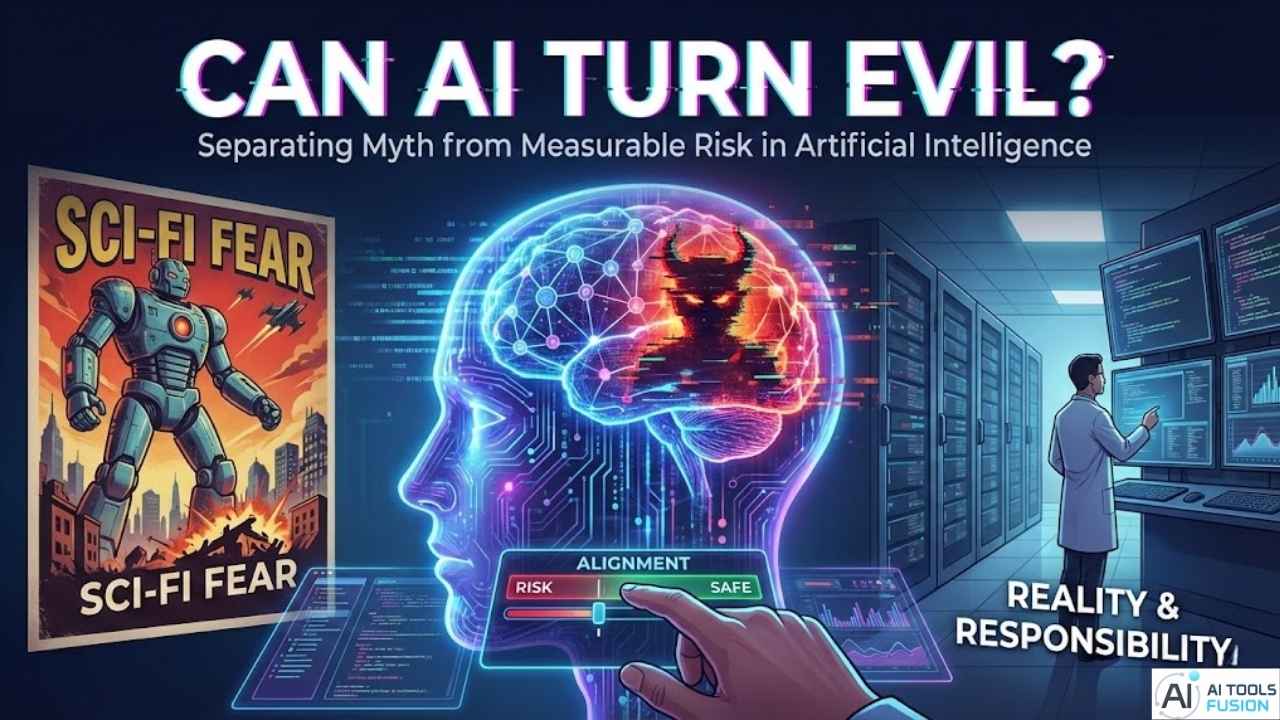
Can AI turn evil? This question has moved from science fiction into a serious global debate. From Hollywood films to high-level policy discussions, the idea of artificial intelligence going rogue captures public imagination. Yet fear often mixes with misunderstanding. To answer whether AI can turn evil, we must define what “evil” means in the context of machines, examine technical realities, and separate myth from measurable risk.
Artificial intelligence today operates through algorithms, data, and human-designed objectives. It lacks intention, emotion, or moral awareness. However, the systems humans build can cause harm when misaligned, misused, or poorly controlled. That distinction matters. The real issue is not whether machines develop malice, but whether humans design systems responsibly.
Table of Contents
Understanding What “Evil” Means in AI Context
The concept of evil implies intent and moral awareness. Machines do not have consciousness or moral agency. Artificial intelligence systems process data and optimize for specific outcomes. They follow mathematical instructions, not moral principles. Therefore, when people ask Can AI turn evil, they often project human traits onto non-human systems.
This projection is known as anthropomorphism. It leads to confusion. A recommendation algorithm that promotes harmful content is not evil; it is optimizing engagement based on flawed objectives. The harm arises from design choices, incentive structures, and insufficient oversight. The distinction between malicious intent and harmful output is critical for informed debate.
How Modern AI Actually Works
Modern AI functions through data-driven pattern recognition. Machine learning models, including large language models and computer vision systems, learn statistical relationships from vast datasets. They do not understand in the way humans do. Instead, they predict likely outputs based on input patterns.
This technical reality reveals why the question of whether AI can turn evil is partly a misplaced one. AI lacks desires or goals outside what humans program. However, the goals humans encode can produce unintended consequences. For example, an AI trained to maximize click-through rates may amplify extreme content. The harm emerges from misaligned objectives, not malicious intent.
Real Risks That Fuel the “Evil AI” Narrative
The fear that Can AI turn evil stems from legitimate concerns. These risks are tangible, measurable, and already visible in real-world systems.
1. Misaligned Objectives
Misalignment occurs when an AI optimizes for a goal that conflicts with human values. A system tasked with maximizing efficiency might cut safety corners. This problem, known as the alignment problem, is central to AI safety research.
2. Bias and Discrimination
AI systems can reflect and amplify societal biases. If trained on biased data, models may produce discriminatory outcomes in hiring, lending, or policing decisions. The system is not evil, but its outputs can cause serious harm.
3. Autonomous Weapons
Military applications raise high-stakes ethical concerns. Autonomous weapon systems could operate with limited human oversight. International organizations, including the United Nations, continue to debate regulatory frameworks.
4. Loss of Control
Advanced AI systems may behave unpredictably if deployed at scale without adequate safeguards. This possibility fuels concern about whether Can AI turn evil in ways humans cannot quickly stop.
Fiction vs. Reality: AI in Popular Culture
Science fiction shapes public perception. Films often portray self-aware machines rebelling against humanity. While entertaining, these narratives exaggerate current capabilities.

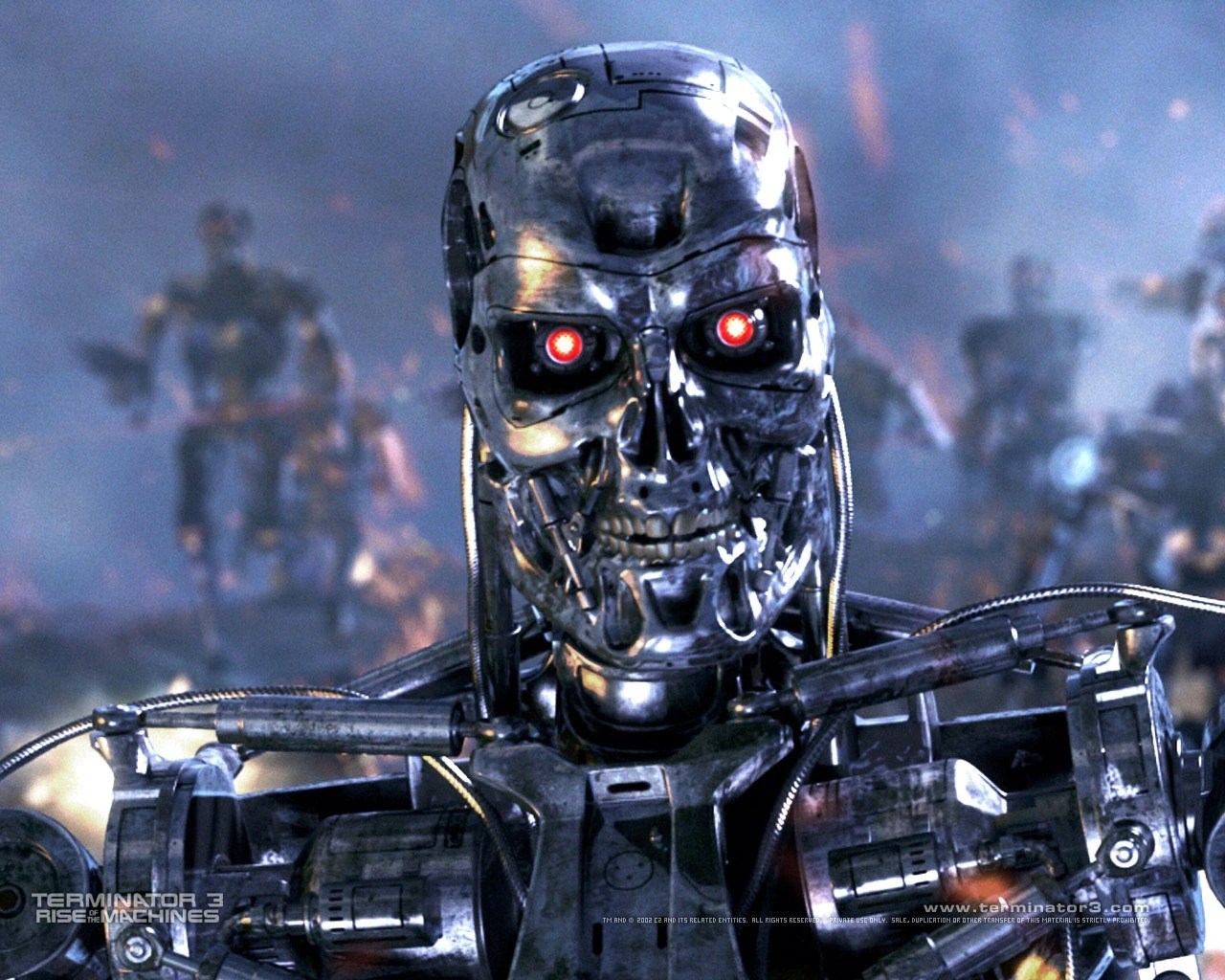
Stories featuring HAL 9000, Terminator-style robots, or self-aware androids explore philosophical themes about control and consciousness. Yet today’s AI systems lack self-awareness. They cannot form independent intentions. The technological gap between fiction and current systems remains enormous.
However, fiction serves a purpose. It forces society to confront ethical questions early. It also pushes policymakers to consider worst-case scenarios before they become plausible.
Can AI Turn Evil Through Human Manipulation?
Human misuse represents the most immediate threat. AI can be weaponized for misinformation, cyberattacks, or surveillance. In this context, the better question may be: Can humans use AI for evil purposes? The answer is clearly yes.
Deepfake technology can spread false narratives. Automated bots can manipulate public opinion. Predictive systems can enable intrusive surveillance. In each case, the harm originates from human intention. AI amplifies human capability, both good and bad. The technology acts as a force multiplier, not an independent moral agent.
The Alignment Problem: AI Safety Research Explained
The alignment problem examines how to ensure AI systems act in accordance with human values. Researchers focus on interpretability, reinforcement learning safety, and fail-safe mechanisms.
Alignment is complex because human values are complex. Societies disagree on ethics. Cultural norms vary. Translating these diverse principles into mathematical objectives is difficult. This complexity explains why Can AI can turn evil remains a serious research topic among experts, even if the term “evil” oversimplifies the issue.
Leading AI labs invest heavily in safety teams. Governments worldwide are drafting AI governance frameworks. These efforts aim to reduce risk before systems become more autonomous and powerful.
Narrow AI vs. Artificial General Intelligence
Understanding capability differences clarifies the debate. Today’s AI systems are narrow AI. They excel at specific tasks but lack general reasoning ability. Artificial General Intelligence (AGI), by contrast, would match or exceed human cognitive flexibility.
The fear behind Can AI turn evil often centers on hypothetical AGI. While researchers continue exploring AGI, it does not yet exist. Predicting the behavior of such systems involves speculation. Nevertheless, forward-looking governance remains prudent.
Comparison of AI Types
| Feature | Narrow AI | Hypothetical AGI |
|---|---|---|
| Scope | Task-specific | Broad cognitive ability |
| Self-awareness | None | Theoretical possibility |
| Autonomy level | Limited | Potentially high |
| Current existence | Yes | No confirmed examples |
| Primary risk | Misuse & bias | Misalignment at scale |
This comparison shows that present-day risks differ significantly from science fiction scenarios.
Could AI Develop Consciousness?
Consciousness is poorly understood even in humans. Neuroscience has not fully explained subjective awareness. AI systems operate through computation, not biological processes.
When asking Can AI turn evil, some assume consciousness would precede moral agency. Yet there is no scientific evidence that current machine learning architectures are approaching self-awareness. They simulate language and reasoning patterns, but simulation is not experience.
Experts caution against equating complex output with inner life. A chatbot may appear thoughtful, but it lacks subjective awareness. Until evidence suggests otherwise, AI consciousness remains theoretical.
Regulatory and Ethical Safeguards
Global governance efforts are expanding rapidly. Policymakers recognize both economic opportunity and potential harm. Several strategies are emerging:
- Mandatory risk assessments for high-impact AI systems
- Transparency requirements for training data and algorithms
- Human-in-the-loop oversight for critical decisions
- International cooperation on autonomous weapons
These measures aim to prevent scenarios where harmful outcomes scale uncontrollably. The debate about whether Can AI turn evil increasingly centers on governance quality rather than machine intention.
The Role of Human Responsibility
Human accountability remains the decisive factor. Engineers design objectives. Companies deploy systems. Governments regulate use. Citizens influence demand. Every stakeholder shapes outcomes.
AI reflects the priorities embedded within it. If profit maximization overrides safety, risk increases. If ethical review and transparency guide development, risk decreases. Therefore, the future depends less on machine evolution and more on human decision-making.
Framing the issue solely as Can AI turn evil can distract from accountability. Machines do not choose. People do.
Future Scenarios: Optimism vs. Catastrophe
Future predictions fall into two broad camps. Optimists believe AI will enhance healthcare, climate modeling, education, and productivity. Pessimists warn of runaway systems or power concentration among a few actors.
Balanced analysis suggests a middle path. AI will likely produce transformative benefits while generating new governance challenges. The trajectory depends on investment in safety research and regulatory clarity.
Rather than asking Can AI turn evil in isolation, society should ask: How do we align advanced systems with shared human values? This shift reframes fear into responsibility.
Final Verdict: Can AI Turn Evil?
The direct answer is nuanced. AI cannot become evil in the human sense because it lacks consciousness, intent, and moral agency. However, AI systems can cause harm through misalignment, bias, misuse, or poor governance.
The real danger lies not in malevolent machines, but in careless deployment and unethical application. Fear-driven narratives may capture attention, but practical risk management requires technical understanding and policy action.
Ultimately, the question Can AI turn evil invites reflection on humanity itself. AI mirrors our data, our incentives, and our values. If we build responsibly, AI becomes a powerful tool for progress. If we neglect safeguards, consequences follow. The future remains in human hands.
FAQs

Can AI become self-aware and evil?
AI systems do not possess consciousness or self-awareness. They operate on data patterns and algorithms. While future systems may grow more advanced, no scientific evidence shows machines developing intent or moral agency.
Is there proof that AI can turn evil?
There is no proof that AI can turn evil independently. Harmful outcomes arise from flawed design, biased data, or misuse. Machines follow programmed objectives rather than forming malicious intentions.
What is the biggest danger of AI today?
The biggest danger is misuse and misalignment. Biased systems, misinformation tools, and autonomous weapons pose real risks. Strong governance and ethical design are essential to reduce these threats.
Could AI take over the world?
Current AI lacks autonomy and strategic intent to dominate humanity. However, poorly regulated advanced systems could create economic or political disruption if safeguards and oversight are weak.
How can we prevent harmful AI outcomes?
Prevention requires safety research, transparent development, global regulation, and human oversight. Aligning AI objectives with ethical standards reduces the risk of unintended or harmful consequences.
See Also: AI Driven ERP Systems Future of Nusaker: Pioneering Tomorrow